

Casino games are designed around a simple mathematical principle: over a large number of plays, the casino expects to keep a portion of the money wagered. This built-in advantage is known as the house edge.
Understanding the house edge is important for anyone interested in casino games because it explains why casinos can remain profitable while still paying winning players. It also shows why short-term results can differ significantly from long-term mathematical expectations.
What Is the House Edge?
The house edge is the mathematical advantage a casino has over players in a particular game. It is normally expressed as a percentage of the total amount wagered.
For example, if a game has a theoretical house edge of 5%, the mathematical expectation is that the casino will retain about $5 for every $100 wagered over a sufficiently large number of bets. This does not mean a player will necessarily lose $5 after wagering $100. Individual results can be very different because of chance and variance.
The house edge is therefore a long-term statistical expectation, not a guaranteed result for every player or every session.
Why Do Casinos Need a House Edge?
Casinos operate businesses with significant expenses, including employees, buildings, technology, licensing, security, marketing, and payment processing. The house edge provides the mathematical foundation for generating revenue from casino games.
Without an advantage built into the games, a casino would generally have difficulty covering its operating costs over the long term.
The edge also allows casinos to pay players when they win while maintaining a positive mathematical expectation across the entire player population.
How Is the House Edge Created?
The house edge is usually created through the rules and payouts of a game.
A game may give players a certain probability of winning but pay slightly less than the mathematically fair amount. Alternatively, the rules may give the casino a particular advantage in specific situations.
This difference between the fair mathematical expectation and the actual rules produces the house edge.
House Edge in Roulette
Roulette provides a straightforward example.
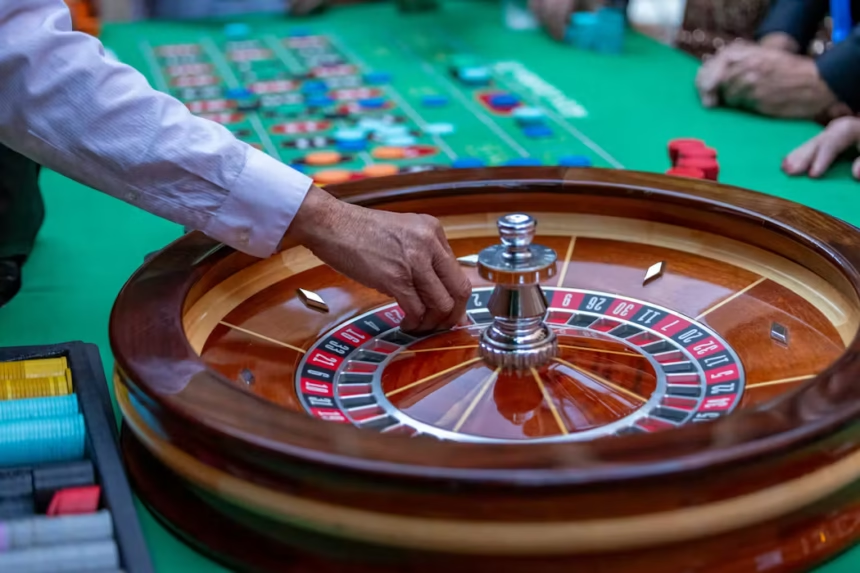
In American roulette, the wheel contains 38 pockets: numbers 1 through 36 plus 0 and 00. A straight-up bet on one number pays 35 to 1, even though there are 38 possible pockets.
Because the payout does not fully compensate for the probability of winning, the casino has a mathematical advantage.
European roulette has 37 pockets because it contains a single zero rather than both 0 and 00. Consequently, its standard house edge is lower than that of American roulette.
This illustrates how a seemingly small rule difference can significantly affect the mathematical expectation of a game.
House Edge in Blackjack
Blackjack works differently because player decisions influence the outcome. Players choose whether to hit, stand, split, double down, or take other available actions depending on the rules.
When played using mathematically optimal basic strategy under particular rules, blackjack can have a relatively low house edge compared with many other casino games.
However, the actual edge depends on factors such as the number of decks, dealer rules, blackjack payout, doubling restrictions, splitting rules, and other table conditions.
Poor playing decisions can also increase the casino’s advantage.
House Edge in Slot Machines
Slot machines use a different mathematical structure. Each spin is governed by programmed probabilities and payout configurations.
A slot game may advertise a theoretical return-to-player percentage, commonly called RTP. If a machine has a theoretical RTP of 96%, its corresponding theoretical house edge is approximately 4%.
This does not mean a player who wagers $100 will receive exactly $96 back. RTP describes long-term statistical behavior across a very large number of spins.
Individual sessions can produce substantially different results.
Return to Player and House Edge
RTP and house edge describe two sides of the same mathematical relationship.
If a game has a theoretical RTP of 95%, the house edge is approximately 5%.
The basic relationship can be expressed as:
House Edge = 100% − RTP
For example, a theoretical RTP of 97% corresponds to a 3% house edge.
These figures are useful when comparing game mathematics, but they should not be interpreted as predictions of what a particular player will win or lose during a short session.
Why Players Can Still Win
A house edge does not mean the casino wins every individual bet.
Random outcomes can produce winning sessions, losing sessions, and everything in between. A player may win a large amount even in a game with a significant house advantage.
The important distinction is between short-term outcomes and long-term expectation.
The longer and more frequently a game is played, the more actual results can tend toward its underlying mathematical expectation, although randomness can still produce substantial variation.
Variance and Volatility
House edge is not the only mathematical feature that matters. Variance, sometimes called volatility in certain gaming contexts, describes how widely outcomes can fluctuate.
Two games could have similar theoretical house edges but produce very different patterns of results.
A lower-variance game may produce smaller and more frequent changes in bankroll, while a higher-variance game may produce larger swings with less predictable short-term results.
Understanding this distinction helps explain why two games with similar theoretical returns can feel very different to play.
Does a Bigger Bet Change the House Edge?
Increasing the size of a wager generally does not change the percentage house edge if the game’s rules remain the same.
However, it increases the amount of money exposed to that mathematical advantage.
For example, if a game has a 4% theoretical house edge, wagering $10 and wagering $100 involve the same percentage expectation, but the dollar amounts associated with the mathematical edge are different.
This is one reason understanding the percentage alone is not enough; the amount wagered and number of bets also matter.
Can Strategy Eliminate the House Edge?
In many standard casino games, a player’s strategy cannot completely eliminate the house edge because the game’s rules are designed to give the casino a mathematical advantage.
However, in games where player decisions affect probabilities, such as blackjack, using mathematically sound strategy can reduce avoidable mistakes and help a player play closer to the game’s theoretical minimum edge.
Promotional terms can also affect the overall mathematics, but bonuses typically come with specific wagering or eligibility conditions that need to be understood before they are evaluated.
Why House Edge Matters More Over Time
The house edge becomes particularly important as the number of wagers increases.
Suppose a game has a theoretical 5% house edge. Over a very large amount of wagering, the casino’s expected gross gaming revenue is related to that percentage.
Individual results can still vary significantly, but repeated play gives the mathematical expectation more opportunity to influence aggregate results.
This is why casinos do not need to win every hand, spin, or round. Their business model relies on the statistical advantage accumulating across many wagers and players.
Does the House Edge Guarantee a Casino Profit?
Not necessarily in every individual situation.
A casino can experience losing days, weeks, or even longer periods on particular games or events because random variation can be substantial.
The house edge represents an expected advantage over a large sample, not a guarantee of profit over every time period.
A casino’s overall financial performance also depends on factors beyond game mathematics, including operating expenses, customer behavior, promotional costs, and the amount wagered.
House Edge and Responsible Gambling
Understanding the house edge can help put casino games into their proper mathematical context.
Casino games should be approached as entertainment rather than as a dependable method of generating income. Players can experience outcomes that differ greatly from theoretical expectations, especially over short periods.
Setting a spending limit, understanding the rules before playing, and avoiding attempts to recover losses through increasingly large wagers are important parts of responsible gambling.
Common Misconceptions About the House Edge
One common misconception is that a casino owes a player a win after several losses. This is generally known as the gambler’s fallacy.
For independent random events, previous results do not automatically make a future outcome more likely. For example, a roulette wheel does not become more likely to land on red simply because several previous spins landed on black.
Another misconception is that a machine or table is necessarily “due” for a big win. Past outcomes alone do not establish that a future random result must compensate for previous losses.
Frequently Asked Questions
What does house edge mean?
House edge is the mathematical percentage advantage a casino has over players in a particular game over the long term.
Is the house edge the amount I will definitely lose?
No. It represents a long-term mathematical expectation. Individual players and sessions can experience very different outcomes.
Which casino games have a house edge?
Most traditional casino games are designed with a mathematical advantage for the casino. The exact percentage varies according to the game’s rules, payouts, and sometimes player decisions.
Is RTP the opposite of house edge?
Generally, yes. If a game has a theoretical RTP of 96%, its corresponding theoretical house edge is approximately 4%.
Can I beat the house edge?
Some games allow players to reduce the effective house advantage through optimal decisions, favorable rules, or certain legitimate strategies. However, standard casino games generally retain a mathematical advantage for the house.
Why do casinos offer bonuses if they already have a house edge?
Bonuses can be used as promotional tools to attract and retain customers. Their actual value depends on the specific terms, wagering requirements, restrictions, and game conditions.
Does playing longer improve my chances of beating the casino?
Longer play does not remove the house edge. Over a large number of wagers, the mathematical expectation becomes increasingly relevant, although short-term variation can remain significant.
Does the house edge mean casinos always win?
No. Casinos can lose money on individual games or over shorter periods. The house edge gives them a statistical advantage over sufficiently large volumes of play rather than guaranteeing every outcome.
Conclusion
The house edge is one of the fundamental principles behind casino gaming. It allows casinos to pay winning players while maintaining a mathematical advantage across a large number of wagers.
Different games create this advantage in different ways. Roulette uses its wheel structure and payouts, blackjack combines rules with player decisions, and slot machines rely on programmed probabilities and theoretical RTP.
Understanding house edge, RTP, variance, and probability can help players make more informed decisions about how casino games work. Most importantly, these concepts demonstrate why casino outcomes are uncertain in the short term while the underlying mathematics gives the house an advantage over extended play.