


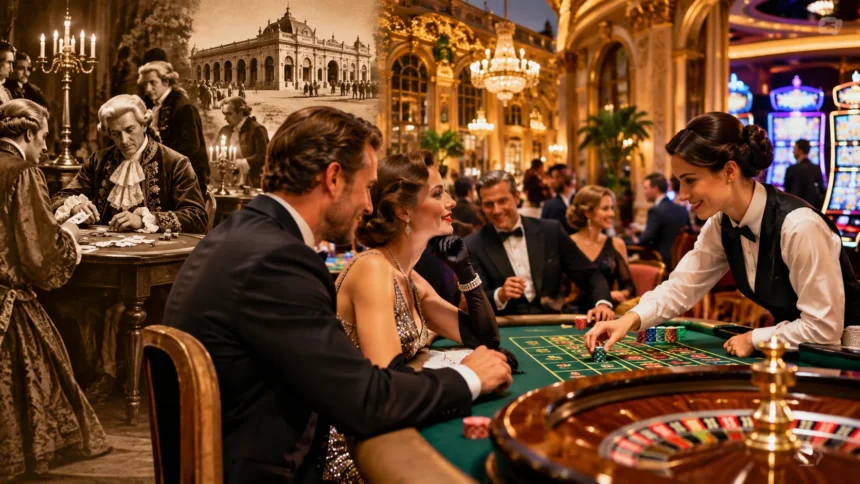
Imagine watching a historical movie where people wear elaborate costumes, speak formally, and follow unfamiliar social traditions. You might wonder whether these customs were genuine historical practices or simply created for the movie.
Exploring casino etiquette history helps answer these questions. Many historical customs developed from social expectations, cultural beliefs, economic differences, and political decisions rather than appearing overnight.
From masked gatherings in Venice to twentieth-century civil rights movements, these traditions reveal much about changing societies. Here are seven historical facts that explain how casino etiquette developed and why its evolution matters.
What Is Casino Etiquette History?
Historical etiquette can be confusing because social expectations change over time. Behavior considered acceptable several centuries ago might be viewed very differently today.
Casino etiquette history examines the social customs, cultural expectations, and institutional rules associated with historical gambling establishments. These traditions were influenced by the values and power structures of their surrounding communities.
Understanding this subject requires looking beyond clothing and formal manners. It also involves examining social inequality, government regulation, cultural identity, and changing public attitudes toward gambling.
1. Historical Venetian Casinos Required Masks
When people think about historical masks, they often associate them with festivals and theatrical performances. However, masks also played an important role in everyday Venetian culture during certain historical periods.
In 1638, Venetian authorities established the Ridotto inside Palazzo Dandolo. This government-regulated gambling establishment reflected many of the city’s existing cultural traditions, including the use of distinctive masks and formal clothing.
Historical paintings frequently depict individuals wearing masks inside these establishments. These visual records provide valuable evidence of how clothing, public identity, and social expectations were connected in Venetian society.
Why Were Masks Culturally Significant?
Masks represented more than decorative accessories. They were connected to traditions surrounding anonymity, public identity, and interactions between individuals from different social backgrounds.
However, wearing similar clothing did not necessarily remove social inequality. Economic circumstances and established social hierarchies continued to influence people’s experiences throughout Venetian society.
Today, preserved paintings and historical clothing collections help researchers understand these traditions. They provide a window into a period when personal appearance carried meanings that modern observers might easily overlook.
2. Formal Clothing Reflected Social Status
Have you ever wondered why historical paintings frequently show people wearing highly decorative clothing? The answer often involves social position rather than individual fashion preferences.
During earlier centuries, clothing communicated information about wealth, occupation, and social standing. Expensive fabrics, elaborate decorations, and formal garments frequently reflected a person’s economic circumstances.
Historical casino establishments existed within these broader cultural systems. Their clothing traditions reflected the same social expectations found in aristocratic gatherings, theaters, private clubs, and other formal environments.
The Relationship Between Clothing and Social Class
Formal clothing was not equally accessible to everyone. Purchasing expensive garments required financial resources that many ordinary workers and families did not possess.
Consequently, appearance-based expectations could reinforce existing social divisions. People without sufficient resources might find themselves excluded from institutions associated with wealthy members of society.
This historical relationship demonstrates why clothing customs deserve critical examination. What might appear to be an elegant tradition could also represent economic inequality and restricted social opportunities.
3. European Casino Culture Reflected Broader Social Traditions
Understanding nineteenth-century European customs becomes difficult when individual establishments are examined without considering their surroundings. These institutions were connected to wider developments in transportation, tourism, urban growth, and commercial leisure.
During the nineteenth century, European spa towns experienced significant cultural and economic changes. Some became associated with hotels, gardens, musical performances, health treatments, and gambling establishments.
The development of railway networks also transformed travel patterns. Different social groups increasingly encountered unfamiliar regional customs, although financial resources continued to determine who could access many facilities.
How Social Expectations Changed
European society was experiencing considerable transformation during this period. Industrialization, urbanization, and the expansion of the middle class introduced new discussions about leisure and respectable public behavior.
Established aristocratic customs gradually encountered changing expectations from commercially successful and professionally employed individuals. These interactions influenced how historians understand nineteenth-century recreational culture.
However, changing social traditions did not eliminate financial risks or moral disagreements surrounding gambling. Historical newspapers and academic research reveal that these activities remained subjects of considerable public debate.
4. Emotional Restraint Was Associated With Respectability
Historical descriptions of formal gatherings often emphasize controlled behavior and emotional restraint. This can seem unusual when compared with contemporary attitudes toward expressing emotions openly.
In nineteenth-century European culture, emotional control was frequently connected to ideas about politeness, dignity, and respectable conduct. These expectations appeared in numerous public and private social settings.
Historians studying gambling culture have also examined how people discussed emotional restraint. Their research reveals connections between social expectations, personal identity, uncertainty, and public expressions of disappointment.
Why Historical Expectations Deserve Critical Examination
Maintaining a composed appearance did not necessarily indicate that someone was experiencing financial or emotional security. Individuals could face considerable difficulties without displaying them publicly.
This distinction remains important when interpreting historical accounts. Paintings and written descriptions often document visible behavior while providing limited information about private experiences and personal circumstances.
Rather than assuming formal behavior represented well-being, researchers examine additional evidence. Personal correspondence, financial records, and contemporary criticism can reveal experiences that polished public appearances concealed.
5. Historical Casino Customs Were Influenced by Gender Roles
Many historical accounts focus heavily on wealthy men, leaving readers with an incomplete understanding of the broader social environment. Women’s experiences were frequently documented differently or received less attention.
Historical research demonstrates that women participated in gambling-related social environments across various periods. However, their experiences were shaped by prevailing gender expectations, economic restrictions, and unequal social opportunities.
During the eighteenth and nineteenth centuries, societies frequently judged similar behavior differently depending on whether it involved men or women. These differences reflected broader inequalities rather than universally accepted principles of fairness.
How Gender Expectations Influenced Public Life
Women in many historical societies experienced limitations on employment, property ownership, education, and independent financial decision-making. These restrictions influenced their experiences across numerous public institutions.
Historical attitudes toward recreation also reflected these inequalities. Behavior considered acceptable for men could attract criticism when associated with women, demonstrating the inconsistency of established social expectations.
Studying these differences helps researchers develop a more complete understanding of historical culture. It also highlights why older traditions should not automatically be treated as examples of fair or respectful behavior.
6. Civil Rights Movements Challenged Discriminatory Customs
One of the most important facts about casino etiquette history involves discrimination. Some historical practices described as established customs were actually forms of exclusion that denied people equal treatment.
During the twentieth century, racial segregation affected numerous American public establishments. Hotels, restaurants, theaters, and gambling facilities were among the institutions where discriminatory practices occurred.
Las Vegas experienced significant racial inequality during its development. African American residents and visitors frequently faced restrictions despite contributing to the city’s workforce, economic growth, and cultural identity.
The Moulin Rouge and the Fight for Equality
The Moulin Rouge opened in Las Vegas in 1955 as a racially integrated hotel and gambling establishment. Its historical significance extends beyond its commercial purpose because it challenged established patterns of racial exclusion.
In March 1960, civil rights representatives, government officials, and business leaders reached an agreement associated with the Moulin Rouge. The agreement marked an important development in ending formal segregation within Las Vegas establishments.
Nevertheless, discrimination did not disappear immediately. Continuing civil rights efforts remained necessary to challenge inequality in employment, housing, education, and other areas of public life.
Why This Historical Development Matters
The history of social customs is incomplete without acknowledging the individuals who challenged discriminatory practices. Many improvements resulted from organized activism rather than gradual changes in personal manners.
The civil rights movement demonstrates that longstanding traditions are not necessarily fair. Customs can reflect unequal power structures, and their historical existence does not justify their continuation.
This lesson extends far beyond casino culture. It encourages readers to examine historical institutions through the principles of equality, human dignity, and social justice.
7. Public Safety Became an Important Regulatory Concern
Earlier historical establishments operated within different legal and regulatory environments. Consequently, public protections varied considerably between regions and historical periods.
As commercial gambling expanded, governments faced questions about financial misconduct, consumer protection, criminal activity, and the wider consequences of gambling-related harm.
These concerns contributed to the development of more formal regulatory systems. The focus gradually extended beyond traditional social customs to include institutional accountability and public safety.
How Public Health Changed the Discussion
Modern public health research recognizes that gambling-related harm can affect individuals, families, and communities. Financial difficulties, strained relationships, and emotional distress are among the potential consequences.
This broader perspective challenges historical interpretations that focus exclusively on formal manners and cultural traditions. Respectable appearances do not necessarily indicate that an institution operates without harmful consequences.
Understanding these developments helps explain why public welfare deserves greater attention than superficial ideas about etiquette. Historical traditions must be considered alongside their social, financial, and ethical implications.
Traditional vs. Modern Casino Culture
Comparing different historical periods can be challenging because cultural development rarely follows a simple pattern. Social expectations vary according to geography, economic conditions, legal systems, and political circumstances.
Nevertheless, examining broad differences between earlier traditions and modern regulatory priorities helps reveal important historical changes.
| Historical Aspect | Traditional Culture | Modern Perspectives |
|---|---|---|
| Clothing | Reflected wealth and social position | Greater recognition of individual expression |
| Social access | Frequently influenced by social hierarchy | Greater emphasis on legal equality |
| Gender expectations | Often unequal and restrictive | Greater recognition of equal rights |
| Emotional expression | Associated with formal restraint | Greater awareness of emotional well-being |
| Regulation | Varied considerably by region | More formal regulatory frameworks |
| Public awareness | Influenced by local cultural beliefs | Increasing recognition of gambling-related harm |
| Institutional responsibility | Often focused on commercial interests | Greater attention to accountability |
These differences should not be interpreted as evidence that every modern institution operates fairly or safely. Legal reforms and changing social attitudes can improve protections, but they do not automatically eliminate harmful practices.
A Brief Timeline of Casino Etiquette History
Historical dates can become difficult to remember when they are presented without context. Connecting important events with broader cultural developments makes the subject easier to understand.
The following timeline highlights several developments associated with historical gambling establishments and changing social expectations.
| Historical Period | Significant Development |
|---|---|
| 1638 | Establishment of the Ridotto in Venice |
| 1700s | Venetian masking traditions reflected wider social customs |
| 1800s | European commercial leisure culture expanded |
| 1931 | Nevada legalized gambling |
| 1955 | The integrated Moulin Rouge opened in Las Vegas |
| 1960 | The Moulin Rouge Agreement challenged racial segregation |
| Late 20th century onward | Increasing attention to regulation and public protection |
This timeline demonstrates that historical etiquette did not evolve independently. Cultural movements, political decisions, economic changes, and civil rights campaigns all influenced its development.
Different regions also experienced these changes at different times. A single timeline cannot represent every country’s historical experience or cultural traditions.
Common Misconceptions About Historical Casino Etiquette
Movies, fictional stories, and popular culture sometimes present historical gambling establishments through selective or romanticized images. These portrayals can create misunderstandings about the realities of earlier societies.
One common misconception is that formal clothing reflected universal respect and equality. In reality, expensive garments and exclusive social traditions could reinforce substantial differences in wealth and status.
Other common misconceptions include:
- Historical customs were identical across every European country.
- Formal behavior indicated emotional and financial well-being.
- Earlier establishments provided equal treatment to everyone.
- Social traditions developed independently of political changes.
- Historical entertainment culture existed without financial or social consequences.
Recognizing these misconceptions helps readers distinguish historical evidence from fictional storytelling. It also encourages a more balanced interpretation of institutions that affected communities in complicated ways.
Why Studying Historical Etiquette Matters Today
At first, studying centuries-old social customs might seem unrelated to everyday life. However, historical etiquette reveals valuable information about how societies establish expectations and distribute power.
Examining clothing traditions helps explain historical class divisions. Studying discriminatory practices reveals the importance of civil rights, while examining regulatory developments demonstrates changing attitudes toward public protection.
These lessons encourage critical thinking about established traditions. Instead of assuming that a custom is beneficial simply because it has existed for a long time, readers can evaluate its origins and consequences.
How to Explore Casino History Through Reliable Sources
Historical information becomes difficult to trust when websites repeat claims without identifying their origins. Fictional stories and promotional content can further blur the distinction between evidence and interpretation.
Reliable historical research begins with sources that document the period being studied. Museum collections, academic publications, historical newspapers, and university archives provide useful starting points.
When researching historical social customs, consider these questions:
- Who created the historical record?
- When was the information documented?
- Whose experiences are missing from the account?
- Does independent research support the historical claim?
Comparing different historical sources helps identify inconsistencies and missing perspectives. It also makes historical research more meaningful by encouraging readers to examine evidence rather than accepting familiar stories without question.
Conclusion
Exploring casino etiquette history reveals a complicated relationship between cultural traditions, social expectations, economic inequality, and political developments. From Venetian masking customs to American civil rights movements, each period contributed to changing ideas about public behavior.
These seven historical facts also demonstrate why etiquette should not be confused with fairness or safety. Some established customs reinforced discrimination, while later reforms challenged inequality and introduced greater institutional accountability.
Take your next step by exploring historical paintings, university archives, and museum collections. Studying these records will help you understand how societies change, why certain traditions disappear, and how historical lessons can inform more thoughtful decisions today.
Frequently Asked Questions
When did casino etiquette history begin?
Some of its documented early traditions can be traced to the Ridotto, established in Venice in 1638. Its customs reflected existing Venetian cultural practices and social expectations.
Why did people wear masks in historical Venetian casinos?
Masks were connected to Venetian cultural traditions surrounding identity and anonymity. Their historical significance extended beyond gambling establishments and reflected wider social practices.
Why was formal clothing important in historical casino culture?
Formal clothing frequently communicated wealth, social status, and cultural identity. Clothing expectations also reflected economic inequalities and established social divisions within earlier societies.
How did civil rights movements influence casino history?
Civil rights movements challenged discriminatory policies that restricted equal access to public establishments. The 1960 Moulin Rouge Agreement was an important milestone in addressing segregation in Las Vegas.
How has casino etiquette evolved over time?
Historical customs have changed alongside cultural attitudes, civil rights developments, legal reforms, and public health research. These changes reflect broader developments in society rather than etiquette alone.