

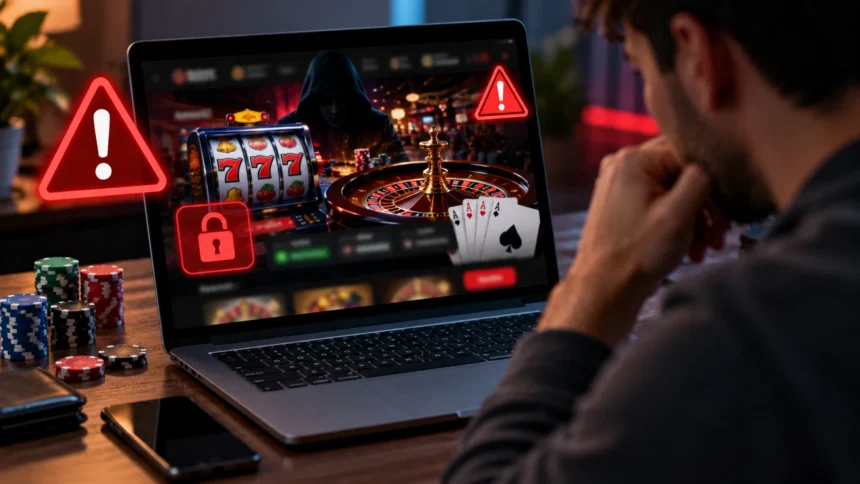
Online casino scams can expose people to financial losses, identity theft, and serious privacy risks. Fraudulent gambling websites may appear professional while hiding misleading terms, fake credentials, and dishonest business practices. Recognizing the warning signs of an untrustworthy online casino is important for understanding online fraud and protecting personal information.
Some suspicious gambling websites imitate established businesses, display questionable security claims, or advertise unrealistic financial rewards. Others may collect sensitive details without explaining how that information will be used. These practices can make it difficult to distinguish genuine business information from deliberately misleading marketing.
Understanding common online casino warning signs can help people recognize suspicious websites before sharing information or making financial decisions. This guide explains the risks associated with fake licensing claims, hidden conditions, misleading advertisements, withdrawal complaints, and inadequate customer support. It also covers practical steps for responding to suspected scams and protecting your digital security.
What Makes an Online Casino Untrustworthy?
An untrustworthy online casino is a gambling website that uses deceptive practices, provides misleading information, or fails to protect users appropriately. Some websites may operate without the authorization required in their jurisdiction, while others falsely claim to follow established regulatory standards. These problems can expose visitors to financial and privacy risks.
Dishonest gambling websites may advertise unrealistic rewards, conceal important conditions, or make it difficult for customers to contact the business. Some deliberately imitate legitimate companies through copied branding and misleading website addresses. Their professional appearance can create a false impression of credibility.
It is also important to understand that a professional-looking website is not proof of trustworthy behavior. Attractive graphics, positive testimonials, and security symbols can be copied or fabricated. Recognizing these limitations helps people evaluate suspicious claims critically instead of relying on a website’s appearance.
1. Missing or Fake Licensing Information
One major warning sign is a gambling website that provides no meaningful information about its legal identity or regulatory status. Some platforms display vague statements about being internationally approved without identifying a responsible authority. Others may use official-looking symbols that cannot be independently verified.
Fake licensing claims can create the impression that a website is subject to oversight when it is not. A copied logo or certificate image does not establish that a business holds valid authorization. Fraudulent operators sometimes use the identities of unrelated companies to appear more credible.
Licensing requirements also differ across jurisdictions, and a claim of authorization elsewhere does not automatically mean an online gambling service is legal locally. For minors, gambling services are not appropriate regardless of their licensing claims. Missing or misleading authorization information should be treated as a serious reason to avoid engaging with a website.
2. Unrealistic Bonuses and Guaranteed Winning Claims
Promises of guaranteed winnings are a major warning sign of misleading gambling advertising. Gambling outcomes are uncertain, and no legitimate explanation can turn chance-based games into a reliable source of income. Websites suggesting otherwise may be trying to encourage risky financial decisions.
Some fraudulent platforms use exaggerated rewards or promotional language designed to create urgency. Advertisements may claim that users can earn substantial amounts of money almost immediately. These statements can distract from hidden conditions, financial risks, or the possibility that advertised rewards do not exist.
A useful general principle is to question offers that promise easy money without clearly explaining the underlying risks. Pressure to respond quickly can be another indicator of manipulation. Avoid sharing financial information or transferring money based on promotional claims that appear unusually generous or guaranteed.
3. Hidden Terms and Misleading Conditions
Unclear terms and conditions can make a website difficult to understand and may indicate deceptive business practices. Suspicious platforms sometimes display prominent promotional claims while placing important restrictions in obscure sections of their websites. This lack of transparency can prevent users from understanding what the business is actually offering.
Examples include contradictory rules, unexplained charges, and conditions that appear only after someone has provided personal information. A website may also reserve broad powers to change its terms without offering a clear explanation. Such practices can create opportunities for unfair treatment.
Legal documents do not automatically make a business trustworthy, especially when their content is confusing or misleading. People should be cautious when important information is unavailable or inconsistent. A platform that conceals basic conditions should not be trusted with sensitive information or payments.
4. Reports of Delayed or Missing Withdrawals
Repeated complaints about missing payments can be an important warning sign of financial misconduct. Some fraudulent gambling websites accept money but later refuse to return funds or explain payment problems. Others provide changing explanations that prevent affected individuals from understanding what happened.
Delayed payments do not always prove fraud because financial services can experience legitimate technical or administrative problems. However, repeated complaints involving unexplained refusals, contradictory information, or demands for additional payments deserve serious attention. Patterns are often more informative than a single isolated report.
People who believe a website is withholding their money should avoid sending additional funds in response to unexpected demands. Keeping relevant transaction records and contacting their bank or payment provider can help them understand available protections. Financial disputes involving suspected fraud may also warrant reporting to appropriate consumer protection authorities.
5. Poor Website Security and Privacy Protection
Weak website security can expose visitors to identity theft, account compromise, and unauthorized access to personal information. Suspicious gambling platforms may request sensitive details without clearly explaining how those details are protected. Some websites also use misleading messages to persuade visitors to disclose information.
A secure connection is important for transmitting data, but the presence of HTTPS does not prove that a website is honest. Fraudulent websites can also use encrypted connections. Security claims should therefore never be treated as sufficient evidence of legitimacy on their own.
Warning signs may include requests for unnecessary personal documents, unclear privacy policies, and suspicious links that direct users to unrelated websites. Avoid submitting identification or financial details to an unfamiliar gambling platform. If information has already been exposed, taking steps to secure affected accounts may help reduce further harm.
6. Missing Company and Contact Information
An untrustworthy website may provide little information about the business responsible for its operation. Important details such as a legal company name, meaningful contact information, or a clear explanation of business ownership may be missing. This lack of transparency makes accountability more difficult.
Some websites display generic contact forms without identifying who receives the messages. Others provide inconsistent company names across different pages. In more deceptive cases, operators may copy addresses or business identities from unrelated organizations to create a misleading impression.
Missing contact details are not conclusive proof of fraud, but they are a significant concern when combined with other warning signs. Visitors should avoid assuming that a website is credible because it lists an email address or phone number. Contact information can also be fabricated.
7. Fake Customer Reviews and Testimonials
Customer testimonials can be manipulated to create a false impression of satisfaction and reliability. Fraudulent gambling websites may publish invented success stories or display photographs associated with fictional users. These claims are often designed to encourage trust without providing meaningful evidence.
Suspicious testimonials sometimes use repetitive language, exaggerated financial claims, or identical statements across unrelated websites. Reviews may also avoid discussing practical concerns such as financial disputes, privacy, or customer service. A collection of uniformly positive comments should not automatically be interpreted as reliable information.
Online reviews can also reflect individual experiences that are difficult to verify independently. Understanding this limitation is important when assessing any internet business. Strong promotional claims, especially those suggesting guaranteed financial outcomes, should be treated cautiously rather than accepted as proof of credibility.
8. Pressure to Make Immediate Payments
Pressure-based tactics are common in many forms of online financial fraud. Suspicious websites may claim that an opportunity will disappear unless someone transfers money immediately. These messages attempt to reduce the time available for careful thinking and independent consideration.
Some scams involve repeated demands for additional payments after an initial transaction. Fraudsters may invent administrative charges, processing expenses, or other reasons why more money supposedly must be sent. The demands may continue without delivering the promised outcome.
Anyone facing unexpected payment pressure should avoid making further transfers until the situation has been independently assessed. If financial information has already been shared, contacting the relevant bank or payment provider is a sensible protective step. Urgent demands should never replace clear documentation and informed financial decisions.
9. Suspicious Payment Requests
Unusual payment instructions can indicate that a website is attempting to avoid accountability or exploit visitors. Examples include requests to send money to unrelated individuals or unexpected changes to payment details. Fraudulent operators may also encourage transactions that are difficult to dispute or recover.
A particularly serious warning sign is being instructed to pay an additional fee before previously promised funds can be released. This pattern appears in many types of advance-fee fraud. The original promise may be used to convince someone that another payment is necessary.
People should be cautious about providing financial information to unfamiliar websites. If a suspicious transaction has occurred, reporting it promptly to the bank or payment provider may improve the chances of protective action. Avoid sharing one-time verification codes, account passwords, or other confidential credentials with website representatives.
10. Unresponsive or Misleading Customer Support
Customer support problems can be another indicator of an unreliable business. Some fraudulent websites provide automated responses that never address the actual concern. Others stop communicating when users question charges, request explanations, or report suspicious activity.
Poor communication does not always establish deliberate fraud, but repeated avoidance of important questions should raise concerns. Conflicting information from different representatives can also make it difficult to understand the company’s policies. A lack of clear responsibility may leave affected individuals without meaningful assistance.
Be particularly cautious when supposed support representatives request passwords, verification codes, or additional payments through private messages. These requests can indicate impersonation or phishing. Legitimate financial institutions should be contacted through independently known channels when account security is involved.
11. Misleading Game Fairness and Winning Claims
Some online gambling websites make misleading statements about how their games operate. Claims that a particular outcome is guaranteed or that previous losses make future wins more likely can distort the nature of chance-based activities. Such claims may encourage people to misunderstand financial risk.
In games involving independent random outcomes, previous results do not guarantee what will happen next. A sequence of losses does not establish that a win is due. Fraudulent marketing may exploit this misunderstanding by presenting uncertain events as predictable opportunities.
A website that promises control over random outcomes should be treated with skepticism. Even claims involving technical testing or fairness certificates can be misleading if they are fabricated. Understanding basic probability helps people recognize advertising that exaggerates certainty or encourages unsafe financial expectations.
12. Fake Casino Websites and Brand Impersonation
Brand impersonation is a common online scam technique. Fraudsters may create websites that resemble familiar businesses, copying logos, colors, page layouts, and promotional language. Their goal is often to persuade visitors to enter personal details or make payments under false assumptions.
These imitation websites may use slightly altered domain names or links distributed through unsolicited messages. Some can look convincing at first glance, especially on mobile devices where website addresses are less visible. Professional-looking design does not guarantee that the site belongs to the company it appears to represent.
Avoid opening suspicious links from unexpected emails, advertisements, or private messages. If a message claims that an existing financial account is affected, use a separately known official contact channel. Reporting impersonation attempts can also help reduce the risk to other internet users.
13. Excessive Collection of Personal Information
Fraudulent websites may collect more personal information than is reasonably necessary for the interaction being presented. Sensitive documents, financial account numbers, and detailed identity information can become valuable targets for criminal misuse. Some scams are designed primarily to gather this data.
A website may ask visitors to upload documents without clearly identifying the responsible company or explaining how the information will be stored. Others may repeatedly request the same details through different communication channels. Inconsistent explanations about data collection are another warning sign.
Avoid submitting identity documents or sensitive account information to suspicious gambling websites. If personal details have already been exposed, consider securing relevant accounts and monitoring for unfamiliar activity. Identity theft protections and reporting procedures differ by location, so local official guidance may be useful.
14. Misleading Advertisements and Social Media Promotions
Online casino fraud can spread through social media advertisements, unsolicited messages, and misleading promotional content. Some advertisements show fabricated payment screenshots or dramatic claims about financial success. Others use impersonated public figures or edited endorsements to attract attention.
The presence of a promotion on a popular social media platform does not establish that the advertised service is trustworthy. Fraudulent advertisers can sometimes purchase promotional placements or create convincing-looking accounts. Sponsored visibility should therefore not be confused with independent verification.
Be cautious about messages that promise quick financial rewards or ask for immediate account registration. Avoid following payment links from unknown promotional accounts. Reporting deceptive advertisements through the platform’s available safety tools may help protect other users from similar claims.
15. No Clear Complaint or Dispute Process
An untrustworthy website may provide no meaningful explanation of how complaints are handled. Visitors experiencing payment problems or privacy concerns may find that the company offers no identifiable dispute procedure. This absence can make accountability and consumer protection more difficult.
Some platforms advertise complaint procedures but fail to explain who reviews disputes or how decisions are communicated. Others display vague promises without identifying a responsible business entity. These shortcomings become especially concerning when the website also faces repeated allegations of financial misconduct.
People affected by suspected fraud should not depend entirely on the website’s internal communication channels. Their bank, payment provider, local cybercrime reporting authority, or consumer protection agency may provide alternative avenues for assistance. Keeping accurate documentation can support the reporting process.
What to Do If You Suspect an Online Casino Scam
If you suspect a gambling website is fraudulent, avoid sending additional money or personal information. Do not respond to demands for unexpected fees, passwords, or verification codes. Continuing to engage with suspicious representatives can increase exposure to financial and identity-related harm.
If a payment has already been made, contact your bank or payment provider promptly. Explain the circumstances and ask what protective measures or dispute options are available. Save relevant transaction confirmations, messages, and website details without opening suspicious attachments or downloading unfamiliar files.
You can also report suspected fraud to the appropriate cybercrime or consumer protection authority. The available reporting channels depend on your country and the type of incident. If you are under the legal gambling age, avoid gambling websites entirely and tell a trusted adult about any suspicious payment request or exposure of personal information.
How to Protect Your Personal Information From Gambling Scams
Protecting personal information begins with avoiding suspicious links and websites that request unnecessary details. Fraudulent gambling pages may attempt to collect passwords, identity documents, or financial information through misleading forms. Limiting unnecessary disclosure reduces opportunities for misuse.
Use unique passwords for important accounts and enable multifactor authentication where available. Never share authentication codes with strangers or supposed support representatives. If you have entered a password on a suspicious website, change it through the affected service’s official website or application.
Be careful with unsolicited messages claiming that money, rewards, or account access is waiting for you. These messages may contain phishing links or malicious attachments. Maintaining updated devices and software can provide additional protection against common digital security threats.
Why Online Casino Scams Can Be Financially Harmful
Online casino fraud can cause direct financial losses through unauthorized charges, deceptive payment requests, and stolen account information. Victims may also experience additional expenses while attempting to secure their accounts or resolve identity theft. The financial consequences can extend beyond an initial transaction.
Some scams exploit the belief that sending more money will recover previous losses or unlock a promised payment. This manipulation can lead people to make repeated transfers despite growing uncertainty. Understanding the pattern can help interrupt the cycle before additional damage occurs.
Financial fraud can also create stress and uncertainty for affected individuals and their families. Seeking support from a trusted person, financial institution, or relevant authority can help clarify available options. Responding early is generally preferable to continuing communication with a suspected scammer.
Common Mistakes People Make When Encountering Casino Scams
One common mistake is assuming that professional website design guarantees credibility. Fraudulent operators can create polished pages that resemble established businesses. Attractive graphics and customer testimonials are not reliable substitutes for transparent business information.
Another mistake is trusting claims that losses can be recovered through additional payments. Scammers may present these transfers as temporary charges or processing requirements. In reality, sending more money can increase financial harm without resolving the original problem.
People may also delay reporting suspicious transactions because they feel embarrassed or uncertain. However, fraud can affect individuals with different levels of internet experience. Contacting a bank or appropriate reporting authority quickly can help identify available protective steps and reduce further exposure.
Conclusion
Recognizing the warning signs of an untrustworthy online casino is important for avoiding financial fraud and protecting personal information. Missing company details, misleading advertising, fake licensing claims, and suspicious payment requests can all indicate potential risks. A professional-looking website should never be treated as proof that a business is honest or safe.
Fraudulent gambling platforms may use urgency, unrealistic promises, and confusing conditions to influence financial decisions. Some also collect sensitive information that could be misused for identity theft. Understanding these tactics makes it easier to recognize suspicious behavior and avoid sharing confidential information.
The safest response to a suspected online casino scam is to stop engaging, protect affected accounts, and report relevant financial activity through appropriate channels. Gambling also carries financial risks even when fraud is not involved, and it is not suitable for minors. Awareness, careful handling of personal information, and timely reporting are essential parts of online safety.
Frequently Asked Questions
1. What Are the Biggest Warning Signs of an Online Casino Scam?
Major warning signs include fake licensing claims, guaranteed winning promises, unexplained payment demands, missing company information, and repeated complaints about withheld funds. These indicators deserve serious caution.
2. Can an Online Casino Website Steal Personal Information?
Yes. Fraudulent websites may collect passwords, financial details, or identity documents through misleading forms. Avoid sharing sensitive information with suspicious platforms and secure affected accounts if personal details have already been exposed.
3. Does HTTPS Mean an Online Casino Is Trustworthy?
No. HTTPS encrypts information transmitted between a browser and website, but it does not establish that the website operator is honest. Scam websites can also use secure connections.
4. What Should I Do If an Online Casino Refuses to Return My Money?
Avoid sending additional payments and contact your bank or payment provider. Preserve transaction records and relevant communications, and consider reporting suspected fraud to local cybercrime or consumer protection authorities.
5. Are Guaranteed Casino Winnings Real?
No gambling outcome can be guaranteed simply because a website promises it. Advertisements claiming certain wins or easy income are misleading and should be treated as potential warning signs of financial exploitation.